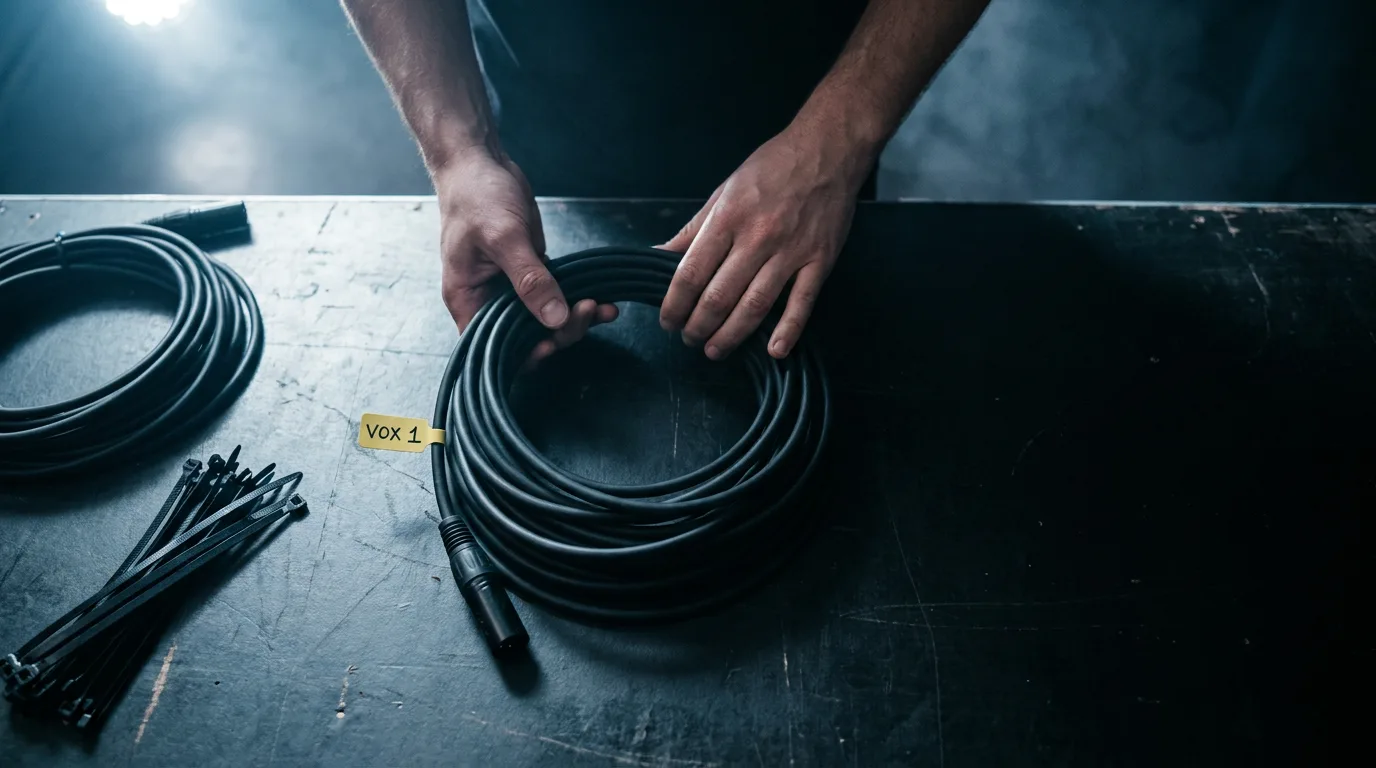
We’ve broken down more DJ booths than we can count, usually at 3am with a promoter standing over our shoulder and the next act’s cases already stacked by the door. The gear survives a rushed teardown fine. The cables don’t, not for long, and neither does your patience the next time you dig through a bag full of tangled leads trying to work out which one goes where. A five-minute teardown only works if you built the system in before doors opened, not while you’re trying to execute it half-asleep.
Set the system up before the gig, not after
The teardown really starts at load-in. If you tag cable ends and coil the way you plan to coil when you pack up, the actual breakdown is just repeating a motion you already did once, hours earlier, wide awake. Skip that step and you end up improvising at the worst possible time, in a dark booth, with a line of people waiting to get past you to the exit.
Color matters here more than people think. Run one tie color for power and a different one for signal, and you can sort a whole bag of cables by feel and low light alone, without reading a single tag. Two colors is enough. Three starts to blur together under a strobe.
The five-minute teardown, step by step
- Tag both ends of every cable when you patch in, not when you pack up. A tag on only one end tells you nothing once the cable is coiled and buried at the bottom of a bag.
- Coil in over-under, not hand-over-hand. Over-under alternates the twist direction every loop, so the cable lies flat instead of fighting you with kinks the next time you unroll it.
- Bundle each coiled cable the second it comes off the deck. A loose coil unrolls itself the moment it hits a bag; a tied one stays a coil until you actually need it again.
- Load the pouch in reverse order of how you’ll need it next time: the cable you’ll grab first goes in last, on top.
- Do a last visual sweep of the booth floor and the back of the mixer before you zip anything shut. This is where a short interconnect or a tag that fell off gets left behind for good.
- Check the venue’s own gear is back where you found it, DI boxes, spare XLRs, the house snake, before you walk out the door.
What actually slows people down
It’s never the big cables. It’s the one unlabeled 3-pin XLR that could be a mic line or a DMX run, the tie that’s gone missing so you’re hand-wrapping a cable with its own end, or a pouch with no fixed slot for anything, so you’re repacking it from scratch every single gig. Fix those three things and the five minutes are real, not aspirational.
The pouch order in practice
Pack the same pouch the same way every time and you stop having to think about where anything is. Ties go in first, at the bottom, because you won’t need them until the next load-in. Coiled cables sit in the middle, longest ones flat against the back so they don’t force the pouch into an odd shape. Tags stay in their own small pocket or a zip compartment, never loose, because a handful of loose metal or leather tags at the bottom of a bag is how you lose three of them in one weekend. The sleeve, if you use one, wraps around the outside of the whole bundle last, both as padding and as the first thing your hand finds when you open the pouch again.
What you need
- Mobile DJ Reset Kit, one pouch sized for exactly this: tags, ties, and a short sleeve, so you’re not assembling a system from loose parts every time.
- engraved cable tag kit for the ends you reuse show after show, so the label survives more than one load-out.
- reusable cable ties in a couple of colors, one for power and one for signal, so you can sort a bag of cables by feel in a dark booth.
Before you leave the booth
Run the same three checks every time, in the same order, so you stop having to think about it. Cables tagged and coiled. Pouch zipped in the order you’ll need it next. Booth floor clear. That’s the whole list. The system only earns its five minutes if you run it exactly the same way every single time, tired or not, good gig or bad one.
None of this is complicated. It’s just the difference between a bag of cables and a kit you can trust at 3am.